Integrated Energy System Simulation
Author: Rongcheng Zheng
Here, we consider the dynamic simulation of the following integrated energy system (IES).
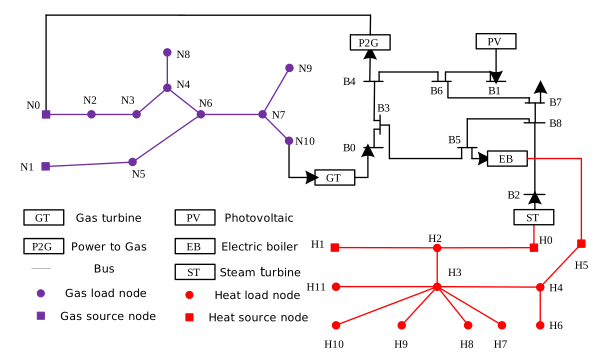
A typical IES consists of three energy subsystems, the electric power system (EPS), the natural gas system (NGS), and the district heating system (DHS), as well as coupling units. In the figure above, the NGS is shown in blue, the EPS in black, and the DHS in red. The specific components of the system are detailed in the legend.
Modelling
Electric Power System
The electric power system equations can be modeled in the following form, where the first two equations are network equations and the last two equations represent node power constraints:
where
\(N_b\) is the number of nodes in the EPS
\(\mathbb{B}_n\) is the set of node indices
\(G_{ij}, B_{ij}\) are the conductance and susceptance between bus \(i\) and bus \(j\)
\(i_{x,i}, i_{y,i}\) are the real and imaginary parts of the current at node \(i\)
\(u_{x,i}, u_{y,i}\) are the real and imaginary parts of the voltage at node \(i\)
\(P_{g,i}, P_{d,i}\) are the generation and demand of active power at node \(i\)
\(Q_{g,i}, Q_{d,i}\) are the generation and demand of reactive power at node \(i\)
Natural Gas System
The natural gas system model consists of pipeline equations and network topology equations.
Gas pipes
For each pipe, the isothermal gas transmission PDEs are
where
\(p\) is the spatial and temporal distribution of pressure
\(q\) is the spatial and temporal distribution of mass flow
\(c\) is the sound velocity
\(S\) is the pipe cross-sectional area
\(\lambda\) is the friction coefficient
\(D\) is the pipe diameter
Network Constraints
The network constraints include mass-flow continuity:
where
\(q_i^\text{in/out}\) is the inlet or outlet mass flow of pipe \(i\)
\(\mathbb{E}_k^\text{in/out}\) is the set of edges flowing into or out of node \(k\)
\(\mathbb{V}\) is the set of nodes
\(q_k\) is the injection mass flow at node \(k\)
and pressure continuity:
where
\(p_k\) is the pressure of node \(k\)
\(p_i^\text{in/out}\) is the inlet or outlet pressure of pipe \(i\)
District Heating System
The district heating system consists of a supply network and a return network. The model contains hydraulic balance, nodal temperature-mixing equations, pipe heat-transport equations, and nodal heat-power equations.
Heat pipes
The temperature field \(T(x,t)\) in a heat pipe satisfies the one-dimensional advection-loss equation
where
\(T\) is the water temperature
\(m\) is the pipe mass flow rate
\(\rho\) is the water density
\(S\) is the pipe cross-sectional area
\(C_p\) is the specific heat capacity
\(\lambda\) is the heat-loss coefficient
\(T^{\mathrm{amb}}\) is the ambient temperature
This equation is applied to both the supply-pipe temperature and the return-pipe temperature. If we denote them by \(T_s^p(x,t)\) and \(T_r^p(x,t)\), then each pipe obeys an equation of the same form.
Hydraulic continuity
At each heating node \(k\), the pipe mass flows satisfy the hydraulic continuity equation
where
\(m_k^{\mathrm{inj}}\) is the nodal injection mass flow rate
\(\mathbb{E}_k^\text{in/out}\) is the set of edges flowing into or out of node \(k\)
\(\mathbb{V}\) is the set of nodes
\(m_i\) is the mass flow of pipe \(i\)
Loop pressure relation
For the hydraulic loop, the network imposes the algebraic pressure-drop balance
where
\(K_i\) is the hydraulic resistance coefficient of pipe \(i\)
\(\sigma_i\in\{-1,0,1\}\) indicates the orientation of that pipe with respect to the selected loop
\(N_p\) is the number of pipes in the selected loop
Supply-side temperature mixing
The supply-node temperature is obtained from an energy-weighted mixing relation. In continuous physical form, for node \(k\),
where
\(T_{s,k}\) is the mixed supply temperature at node \(k\)
\(\dot m_k^{\mathrm{src}}\) is the source or slack injection flow entering the node from a heat source
\(T_k^{\mathrm{src}}\) is the corresponding source temperature
\(\mathcal{I}^{\mathrm{sup}}_k\) is the set of inflowing supply streams
\(T_{r\to k}^{\mathrm{sup}}\) is the temperature of each inflowing supply stream at the node
Return-side temperature mixing
Similarly, the return-node temperature satisfies the mixing law
where
\(\dot m_k^{\mathrm{load}}\) is the return-side load flow
\(T_k^{\mathrm{load}}\) is the prescribed load return temperature
Nodal heat power
At each node, the thermal power is described by the enthalpy difference between supply and return streams:
where
\(\phi_k\) is the thermal power at node \(k\)
\(C_p\) is the heat capacity of water
\(m_k\) is the mass flow at node \(k\)
\(T_{s/r,k}\) are the supply and return temperatures at node \(k\)
For an intermediate node, there is no external heat extraction, so only the hydraulic continuity condition remains.
Coupling units
Gas Turbine (GT): We use the classical Rowen gas turbine model [1]. The controller adjusts the input fuel for prescribed exhaust temperature and rotor speed.
Power to Gas (P2G): Please refer to [2] for the model of P2G.
Photovoltaic (PV): Please refer to [3] for the model of PV. A detailed PV implementation is also available in this cookbook under DAE Examples/Distribution Network Simulation with PV penetration.
Electric Boiler (EB): EB is a common heating device used in heating networks. For a specific model, please refer to [4].
Steam Turbine (ST): The steam turbine model consists of a temperature controller and a steam-volume dynamics module. Details can be found in [5] and [6].
Solution
Pipe equation semi-discretization
Mathematically, the entire IES model consists of a complex system of partial differential-algebraic equations. To perform numerical simulations, the natural gas and thermal pipeline PDEs must be discretized or semi-discretized into algebraic equations or ordinary differential equations. Solverz includes multiple pipeline discretization schemes. Balancing accuracy and simulation speed, we typically use the WENO3 semi-discrete scheme [7] for natural gas pipelines and the KT2 scheme [8] for thermal pipelines.
After semi-discretization, the pipe equations take the form
where \(H_{j+1/2}\) and \(H_{j-1/2}\) denote the numerical fluxes at the discrete interfaces \(j+1/2\) and \(j-1/2\), respectively.
Numerical integration algorithms
After semi-discretizing the pipeline PDEs, the IES model is transformed into a system of differential-algebraic equations (DAEs). Because the electric, gas, and heating subsystems evolve on different time scales, the resulting model is high-dimensional, nonlinear, and strongly stiff. Solverz integrates a streamlined interface for multiple DAE solvers, among which an improved variable-step Rodas4 algorithm demonstrates strong numerical performance [9].
Implementation in Solverz
Here presents the Solverz implementation of IES simulation for the system shown above. The structure data caseI.xlsx and case_heat.xlsx can be found in the related directory of the source repo. PowerFlow(), GasFlow(), and DhsFlow() implement the steady-state calculations for the EPS, NGS, and DHS, respectively, and provide reasonable initial values for the subsequent dynamic simulation. eps_network(), gas_network(), and heat_network() provide simple interfaces for building the dynamic models of the three subnetworks. gt(), eb(), pv(), st(), and p2g() provide simple interfaces for building the coupling-unit models.
"""
Integrated energy system simulation example for Solverz Cookbook.
"""
import os

import matplotlib.pyplot as plt
import numpy as np
from Solverz import Eqn, Model, Opt, Rodas, TimeSeriesParam, Var, made_numerical
from SolMuseum.ae import eb, eps_network, p2g
from SolMuseum.dae import gas_network, gt, heat_network, pv, st
from SolUtil import DhsFlow, GasFlow, PowerFlow

current_dir = os.getcwd()
POWER_CASE = os.path.join(current_dir, "test_ies", "caseI.xlsx")
HEAT_CASE = os.path.join(current_dir, "test_ies", "case_heat.xlsx")
DX = 100
QBASE = 37.41

# %% Power flow
pf = PowerFlow(POWER_CASE)
pf.run()

voltage = pf.Vm * np.exp(1j * pf.Va)
power = (pf.Pg - pf.Pd) + 1j * (pf.Qg - pf.Qd)
current = (power / voltage).conjugate()
ux = voltage.real
uy = voltage.imag
ix = current.real
iy = current.imag

# %% Modelling
model = Model()

gt_0 = gt(
    ux=ux[0],
    uy=uy[0],
    ix=ix[0],
    iy=iy[0],
    ra=0,
    xdp=0.0608,
    xqp=0.0969,
    xq=0.0969,
    Damping=10,
    Tj=47.28,
    A=-0.158,
    B=1.158,
    C=0.5,
    D=0.5,
    E=313,
    W=320,
    kp=0.11,
    ki=1 / 30,
    K1=0.85,
    K2=0.15,
    TRbase=800,
    wref=1,
    qmin=-0.13,
    qmax=1.5,
    T1=12.2,
    T2=1.7,
    TCD=0.16,
    TG=0.05,
    b=0.04,
    TFS=1000,
    Tref=900.3144,
    c=1e8,
)
model.add(gt_0.mdl())

eb_5 = eb(
    eta=1,
    vm0=pf.Vm[5],
    phi=pf.Pd[5] * pf.baseMVA * 1e6,
    ux=ux[5],
    uy=uy[5],
    epsbase=pf.baseMVA * 1e6,
    pd=pf.Pd[5],
    pd0=pf.Pd[5],
)
model.add(eb_5.mdl())

pv_1 = pv(
    ux=ux[1],
    uy=uy[1],
    ix=ix[1],
    iy=iy[1],
    kop=-0.05,
    koi=-10,
    ws=376.99,
    lf=0.005,
    kip=2,
    kii=9,
    Pnom=26813.04395522,
    kp=-0.1,
    ki=-0.01,
    udcref=800,
    cpv=1e-4,
    ldc=0.05,
    cdc=5e-3,
    ISC=19.6,
    IM=18,
    Radiation=1000,
    sref=1000,
    Ttemp=25,
    UOC=864,
    UM=688,
)
model.add(pv_1.mdl())

z = 1e-8
eta = 1
f_steam = 1.02775712
phi = (eta * f_steam - pf.Pg[2]) / z
st_2 = st(
    ux=ux[2],
    uy=uy[2],
    ix=ix[2],
    iy=iy[2],
    ra=0,
    xdp=0.0608,
    xqp=0.0969,
    xq=0.0969,
    Damping=10,
    Tj=47.28,
    phi=phi,
    z=z,
    F=f_steam,
    eta=eta,
    TREF=70,
    alpha=0.3,
    mu_min=0,
    mu_max=1,
    TCH=0.2,
    TRH=5,
    kp=-1,
    ki=-1,
)
model.add(st_2.mdl())

p2g_4 = p2g(
    h=50.18120992,
    eta=0.8,
    epsbase=100,
    c=340,
    p=10e6,
    q=-36.55027730265727,
    pd=pf.Pd[4],
)
model.add(p2g_4.mdl())

epsn = eps_network(pf)
model.add(epsn.mdl(dyn=True))

model.eqn_gt_ux = Eqn("eqn_gt_ux", model.ux_gt - model.ux[0])
model.eqn_gt_uy = Eqn("eqn_gt_uy", model.uy_gt - model.uy[0])
model.eqn_gt_ix = Eqn("eqn_gt_ix", model.ix_gt - model.ix[0])
model.eqn_gt_iy = Eqn("eqn_gt_iy", model.iy_gt - model.iy[0])
model.eqn_eb_ux = Eqn("eqn_eb_ux", model.ux_eb - model.ux[5])
model.eqn_eb_uy = Eqn("eqn_eb_uy", model.uy_eb - model.uy[5])
model.eqn_pv_ux = Eqn("eqn_pv_ux", model.ux_pv - model.ux[1])
model.eqn_pv_uy = Eqn("eqn_pv_uy", model.uy_pv - model.uy[1])
model.eqn_pv_ix = Eqn("eqn_pv_ix", model.ix_pv - model.ix[1])
model.eqn_pv_iy = Eqn("eqn_pv_iy", model.iy_pv - model.iy[1])
model.eqn_st_ux = Eqn("eqn_st_ux", model.ux_st - model.ux[2])
model.eqn_st_uy = Eqn("eqn_st_uy", model.uy_st - model.uy[2])
model.eqn_st_ix = Eqn("eqn_st_ix", model.ix_st - model.ix[2])
model.eqn_st_iy = Eqn("eqn_st_iy", model.iy_st - model.iy[2])

for bus in range(9):
    if bus in [0, 1, 2]:
        continue

    lhs1 = model.ux[bus] * model.ix[bus] + model.uy[bus] * model.iy[bus]
    if bus == 5:
        rhs1 = model.Pg[bus] - model.pd_eb
    elif bus == 4:
        rhs1 = model.Pg[bus] - model.pd_p2g
    else:
        rhs1 = model.Pg[bus] - model.Pd[bus]
    model.add(Eqn(f"eqn_P_{bus}", lhs1 - rhs1))

    lhs2 = model.uy[bus] * model.ix[bus] - model.ux[bus] * model.iy[bus]
    rhs2 = model.Qg[bus] - model.Qd[bus]
    model.add(Eqn(f"eqn_Q_{bus}", lhs2 - rhs2))

gf = GasFlow(POWER_CASE)
gf.run(tee=False)
model.add(gas_network(gf).mdl(dx=DX))

model.eqn_p_p2g = Eqn("eqn_p_p2g", model.p_p2g - model.Pi[0])
model.eqn_q_p2g = Eqn("eqn_q_p2g", model.q_p2g + model.fs[0])
model.fs_0 = TimeSeriesParam("fs_0", [36.5509116, 36.5509116], [0, 100])

for node in range(gf.n_node):
    if node == 1:
        pass
    elif node == 0:
        model.__dict__[f"node_fs_{node}"] = Eqn(f"node_fs_{node}", model.fs[node] - model.fs_0)
    else:
        model.__dict__[f"node_fs_{node}"] = Eqn(f"node_fs_{node}", model.fs[node])

    if node not in [8, 9, 10]:
        gas_load = 0
    elif node in [8, 9]:
        gas_load = gf.fl[node]
    else:
        gas_load = model.qfuel_gt[0] * QBASE
    model.__dict__[f"node_fl_{node}"] = Eqn(f"node_fl_{node}", model.fl[node] - gas_load)

df = DhsFlow(HEAT_CASE)
df.run()
model.add(heat_network(df).mdl(dx=DX, dynamic_slack=True))

model.eqn_st_Ts = Eqn("eqn_st_Ts", model.Ts_st - model.Ts_slack)

for node in range(df.n_node):
    if node not in [0, 1, 5]:
        model.__dict__[f"eqn_phi_hn_{node}"] = Eqn(f"eqn_phi_hn_{node}", model.phi[node] - df.phi[node])
    elif node == 0:
        model.eqn_phi_slack = Eqn("eqn_phi_slack", model.phi[0] * 1e6 - model.phi_st)
    elif node == 1:
        model.eqn_phi_WHB = Eqn("eqn_phi_WHB", model.phi[1] * 1e6 - model.phi_gt)
    else:
        model.eqn_phi_eb = Eqn("eqn_phi_eb", model.phi[5] * 1e6 - model.phi_eb)

omega_coi = (model.Tj_st * model.omega_st + model.Tj_gt * model.omega_gt) / (model.Tj_st + model.Tj_gt)
model.omega_coi = Var("omega_coi", 1)
model.eqn_omega_coi = Eqn("eqn_omega_coi", model.omega_coi - omega_coi)

# %% Solve
sdae, y0 = model.create_instance()
dae = made_numerical(sdae, y0, sparse=True)

sol0 = Rodas(dae, [0, 100 * 3600], y0, Opt(pbar=True))

dae.p["fs_0"] = TimeSeriesParam(
    "fs_0",
    [36.5509116, 47.5509116, 37.5509116],
    [0, 300, 10 * 3600],
)
sol = Rodas(dae, np.linspace(0, 300, 301), sol0.Y[-1], Opt(pbar=True))

# %% Plot
time = np.asarray(sol.T).reshape(-1)
qfuel = np.asarray(sol.Y["qfuel_gt"]).reshape(-1)

plt.plot(time, qfuel, label="qfuel_gt")
plt.xlabel("Time / s")
plt.ylabel("Gas turbine fuel flow")
plt.title("Gas turbine fuel flow under fs_0 disturbance")
plt.grid()
plt.legend()
plt.show()
The dynamic fuel consumption of GT after the gas source N0 mass flow injection disturbance is illustrated below.